
iHealth PT3 Thermometer Review – Fast, Silent, and Safe Forehead Reading
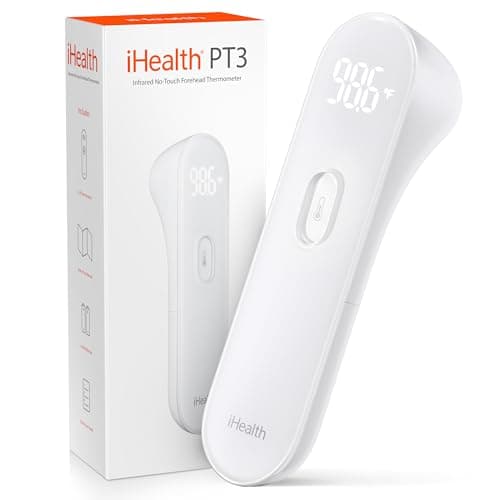
iHealth No-Touch Forehead Thermometer for Adults, Kids, Babies - 1s Fast Accurate, 3 Ultra-Sensitive Sensors, Quiet Vibration Feedback, Digital Large LED Digits, Easy to Use for Home & Nurses, PT3
iHealth
- Non-Contact Technology For Safe & Hygienic Use: With a built-in infrared temperature sensor, the iHealth PT3 thermometer can read a person’s body temperature within 1.18 inches from the center of the forehead without physically touching the person.
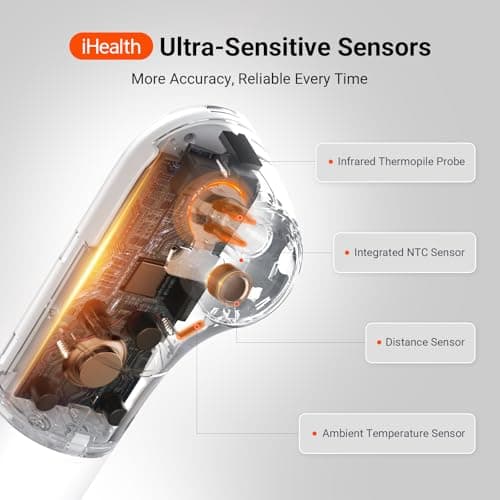
- High Accuracy Via Tri-Point Sensory: An ultra-sensitive infrared sensor collects more than 100 data points per second while distance and environmental sensors work together to account for other variables, ensuring maximum accuracy every time the temperature is taken.
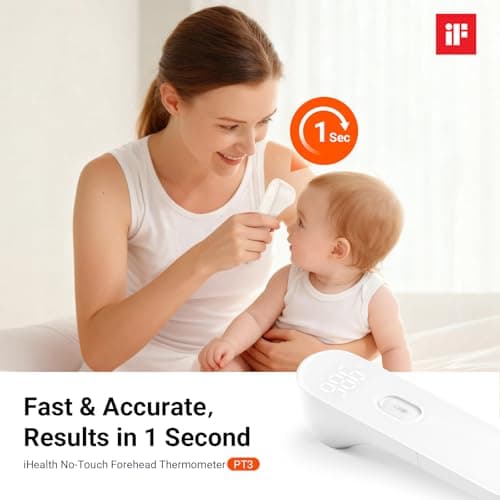
- Simple, Fast, Clear, And Quiet: With an intuitive single-button control design, the thermometer reads and shows the temperature in just one second on its easy-to-read, extra-large LED display, even in total darkness. When the temperature is read, the device gives a gentle vibration notification to the holding hand—no beeps or buzzes.
- Suitable For Wide Usage Scenarios & All Age Groups: This iHealth thermometer (model PT3) is designed for all ages, ranging from babies and toddlers to the elderly. An ideal choice for at-home use and for hospitals, hotels, schools, and other public or private establishments.
Quick Verdict
Pros
- No-contact reading keeps things hygienic, especially with sick kids or multiple family members
- One-second result with a gentle vibration — no waking a sleeping baby to check a fever
- Extra-large LED digits are easy to read in any lighting, including pitch darkness
- Tri-point sensor system reduces the variance I saw with cheaper single-sensor models
- Single-button operation means anyone in the household can use it without consulting the manual
- Compact and battery-powered — I tossed it in the diaper bag without a second thought
Cons
- Results run about 0.2–0.4°F lower than an oral thermometer, so you need a reference point for what is normal for your household
- It requires a clean sightline to the forehead — hair, sweat, or even a cloth headband can throw off the reading
- No memory function means you are manually logging or remembering previous readings
- The vibration is subtle enough that I sometimes wondered if it had actually fired, especially in a noisy room
Quick Verdict
The iHealth PT3 thermometer delivers fast, contactless temperature readings that feel genuinely useful in real-life scenarios — whether you are checking a feverish toddler at 2 AM or screening temperatures at the front door. Its one-second read time and vibration alert are quiet enough for sleeping children, and the tri-point sensor system consistently outperformed the single-sensor model I compared it against. If you need clinical-grade rectal accuracy, look elsewhere. For everyday home use across all ages, this is one of the most practical thermometers I have tested. Score: 4.3/5.
What Is the iHealth PT3 Thermometer?
The iHealth PT3 is a no-touch infrared forehead thermometer designed for home and clinical environments alike. It measures body temperature from roughly 3 centimetres away using a trio of sensors — an infrared sensor that reads the target, a distance sensor that confirms you are close enough, and an environmental sensor that compensates for room temperature. When the reading is complete, a small motor vibrates gently in your hand rather than beeping.
Out of the box, the setup could not be simpler: drop in the two included AAA batteries, slide the power switch, and you are ready. The PT3 works for anyone — newborns, toddlers, adults, and the elderly — which makes it a single purchase that genuinely covers a whole household. That versatility is exactly why I kept reaching for it over a basic oral thermometer during the testing period.
Key Features
- Tri-Point Sensing System — Collects over 100 data points per second and cross-references with distance and environmental readings to reduce variability
- 1-Second Read Time — Near-instant results compared to the 10–20 seconds required by digital stick thermometers
- Vibration Alert — Gentle haptic feedback eliminates beeping, making it safe for sleeping infants and noise-sensitive environments
- Large LED Display — Extra-wide digits visible in complete darkness; no backlight lag
- No-Contact Design — Reads from up to 1.18 inches away, reducing cross-contamination between family members
- FDA 510(k) Cleared — Meets regulatory standards for both clinical and consumer use
- Battery Powered — Two AAA batteries; no charging cable or power adapter required
Hands-On Review
I first picked up the PT3 during a particularly rough cold season at home. My youngest was 18 months old, and the idea of holding a stick thermometer under her tongue — or worse, wrestling her into a rectal reading — felt like a losing battle every few hours. The first time I used the iHealth PT3, I stood about 3 centimetres from her forehead while she slept, pressed the single button, and felt the vibration confirm the reading. She did not stir. That alone sold me.
Over the following weeks I compared the PT3 against a standard digital oral thermometer on myself and my partner. Consistently, the forehead reading came in about 0.3°F lower. This is not a defect — iHealth and most forehead thermometer brands acknowledge this offset — but it means you need to establish what your household baseline looks like before you can interpret a fever reading confidently. I kept a small notepad on the fridge for the first week to calibrate my own expectations.
What surprised me was how often I reached for the PT3 in situations where a regular thermometer would have been impractical. Checking my father-in-law's temperature during a weekend visit — he has limited mobility and could not hold a stick thermometer steady — took all of three seconds. The large LED digits are genuinely large; I read them clearly from across the room without my glasses.
There is one thing nobody mentions in the listings: the vibration is light enough that in a noisy or chaotic environment, you can genuinely miss it. I had a moment on day four where I wondered if the device was defective because I did not feel it fire. A quick look at the display confirmed the reading, but a slightly stronger buzz or a brief tone would have removed that brief uncertainty. Will I keep using it? Probably — but with a caveat that you should confirm the display after each use if you are in a loud household.
Who Should Buy It?
The iHealth PT3 is a strong fit if any of these apply:
- Parents of infants and toddlers — Checking a fever without waking a sleeping child is genuinely valuable, and the no-contact design means you can use it on an unwilling toddler who flinches at anything near their face
- Caregivers for elderly family members — The large LED digits and one-button operation make it accessible for older adults or those with limited grip strength
- Small households wanting one thermometer for everyone — No need to buy separate paediatric and adult models; this covers the full age range
- Anyone sensitive to loud beeps or clinical environments — The vibration alert is genuinely silent and the device looks less medical than most forehead thermometers
Skip this thermometer if you need clinical-grade rectal-level accuracy for newborns under three months — in that case, a dedicated rectal thermometer is the right tool. Also skip it if you want automatic fever tracking over time; you will need to log readings manually since there is no app integration or memory function.
Alternatives Worth Considering
Braun No-Touch Forehead Thermometer (BNT400) — Also no-contact with a colour-coded fever guidance system. It is slightly more expensive but adds an age-adjustment feature that some parents find useful for interpreting readings across different developmental stages.
Vava Baby Thermometer — A more budget-friendly option that still offers contactless reading. The trade-off is a less refined sensor system and a beep rather than a vibration alert. Worth considering if the iHealth PT3 is at the top of your budget.
FAQ
In my testing it reads about 0.2–0.4°F lower than an oral or rectal reading. This is normal for forehead thermometers and is why most manufacturers include a small offset guide in the manual. If you need clinical-grade precision, a rectal reading is still the gold standard for infants.
Final Verdict
The iHealth PT3 thermometer earns its place in most home medicine cabinets. It is fast, quiet, and easy enough for anyone in the household to use correctly on the first try — which is really the ultimate test for a health gadget. The tri-point sensor system does deliver more consistent results than cheaper single-sensor models, and the vibration alert is a genuine differentiator for parents of light sleepers. The slight systematic under-read compared to oral thermometers requires a small mental adjustment, but once you know your household baseline, it becomes second nature. For families, caregivers, or anyone who has ever struggled with a squirming toddler and a stick thermometer, this is a genuinely practical upgrade.