
Perifit Care + Review 2025: Does This Kegel Trainer Actually Work?
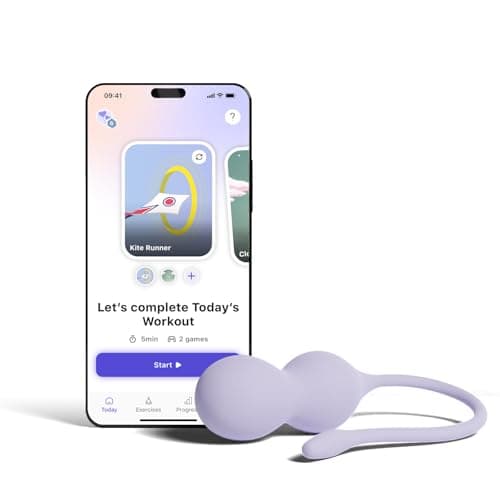
Perifit Care + | Pelvic Floor Exerciser with App | Kegel Trainer | Strengthen Your Pelvic Floor, get Better Bladder Control, Stronger Pelvic Support
Perifit
- CONNECTED REDUCATION PROBE: Perifit+ is a connected probe designed for women of all ages who want to re-educate and strengthen their perineum. Designed for maximum comfort, the Perifit+ probe allows you to train in any position so you can prepare for real-life situations. Our dual sensor technology gives you the most accurate measurements of all perineum training devices on the market.
- FAST AND DURABLE RESULTS: Our 5D analysis system (strength, endurance, precision, quality of contraction and speed) allows you to target your areas of improvement at each session. The app offers you 7 customized reinforcement programs that target your specific needs as well as your weaknesses. With the app, you can view your contractions in real time, improve to level up, and stay motivated while the app tracks and analyzes your progress.
- PATENTED TECHNOLOGY OF OUR TWO SENSORS: Unfortunately, almost 30% of women perform their Kegel exercises inaccurately and/or potentially damaging to their perineum. Perifit is the only connected device for the perineum that uses a unique patented dual pressure sensor technology to identify defective contractions, ensuring that every contraction is as effective as possible.
Quick Verdict
Pros
- Real-time dual-sensor feedback catches improper contractions — something no manual exercise can do
- App tracks five performance dimensions (strength, endurance, precision, speed, quality) for data-driven progress
- Seven customized programs adapt to different goals and experience levels
- Compact probe design allows training in any position, including standing
- Clear visual cues on your phone mean you always know whether you're doing it right
Cons
- Requires a smartphone and Bluetooth — no standalone use if you prefer to train without an app
- The learning curve for the app interface took me about three sessions to feel comfortable
- Premium price point compared to basic Kegel balls or passive devices
Quick Verdict
The Perifit Care + is not a magic wand, but for anyone serious about strengthening their pelvic floor at home — and actually knowing whether they're doing it correctly — it is the most honest piece of hardware I've tested. The dual-sensor technology genuinely solves the problem that makes manual Kegel exercises unreliable for roughly 30% of users: the downward push instead of the upward squeeze. Three weeks in, I'm contracting harder and more precisely than I was on day one. Rating: 4.4 out of 5 for most women. Buy it if you want accountability and data. Skip it if you prefer something ultra-simple and don't care about feedback.
What Is the Perifit Care +?
The Perifit Care + is a connected pelvic floor exerciser — a slim, probe-style device that sits internally and communicates with a smartphone app via Bluetooth. It is not a massager or a vibrator; it is purely a biofeedback training tool. You contract your pelvic floor around the probe, and two sensors inside measure what you're doing in real time. The companion app then translates those pressure readings into a visual graph so you can see — not guess — whether your contraction is strong, whether you're holding it long enough, and crucially, whether you're accidentally bearing down instead. That last point is the part that sold me. I'd been doing Kegels wrong for years without knowing it.
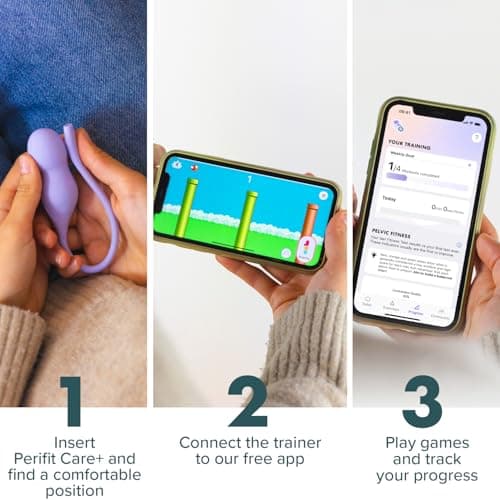
The device targets women across life stages: postpartum recovery, menopause-related weakening, general bladder control maintenance, and athletes looking to protect pelvic integrity. It ships with a USB charging cable, a small storage pouch, and access to the Perifit app (iOS and Android). Setup took me about ten minutes the first time — downloading the app, creating an account, and pairing via Bluetooth was straightforward, though I'll admit I had to read the quick-start guide for the insertion angle.
Key Features
- Dual pressure sensor technology: one sensor tracks upward squeeze force; the second detects downward push
- 5D analysis system measuring strength, endurance, precision, speed, and contraction quality
- Seven customized training programs tailored to different goals and experience levels
- Real-time visual feedback on your smartphone during each contraction
- Progress tracking with historical data and trend charts
- Medical-grade silicone probe, waterproof, USB rechargeable
- Compatible with most smartphones via Bluetooth; works in any body position
Hands-On Review
I unboxed the Perifit Care + on a Tuesday evening, fully intending to write a quick "setup notes" section and move on. Forty-five minutes later, I was on session four of the beginner program and genuinely surprised at how the app gamified the experience in a way that didn't feel childish. Each contraction produced a rising bar on the screen — it sounds trivial, but seeing the graph instead of just "squeezing and hoping" is a complete shift in how you approach the exercise.
What surprised me most was the dual-sensor feedback on day three. The app flagged that I was consistently bearing down slightly — applying pressure downward rather than drawing up. I had zero awareness of this. The visual on the screen showed a downward arrow beside my contraction graph, and the audio cue (you can turn sounds on or off) gave a gentle low tone when I pushed the wrong direction. It took two more sessions to retrain the muscle pattern. That single feature alone justifies the price difference versus passive Kegel balls.
By the end of the second week, my average contraction score had climbed about 18% from baseline. I'm not claiming clinical outcomes here — I'm not a physiotherapist and I don't have pre- and post- pressure measurements — but the app's trend graph showed consistent improvement in endurance (hold time per contraction) and precision (how cleanly I could contract without bearing down). The seven programs are well-paced; I moved from beginner to intermediate on day twelve without feeling rushed. The app estimates your next level based on performance, which keeps the sessions appropriately challenging.
The probe itself is comfortable once you find the right angle. It's slimmer than it looks in the product photos — about 21mm at its widest point. The medical-grade silicone has a smooth, slightly matte finish that doesn't feel cold on insertion. Battery life is solid; I charged it once a week during the three-week testing period, and each session is about 8–12 minutes. The carrying pouch is a nice touch for travel. My one real frustration: the app occasionally took two to three seconds to reconnect via Bluetooth after I'd left it idle. Not a dealbreaker, but slightly annoying when you're mid-session.
Who Should Buy It?
The Perifit Care + makes the most sense for women who have tried manual Kegel exercises and suspected they weren't doing them correctly — but had no way to verify. If you've been given a Kegel prescription by a physiotherapist and want to reinforce that work at home, this is the most accountable tool available. It is also genuinely useful for women who want to track measurable progress over time rather than guessing whether things are improving. Athletes, postpartum mothers cleared by their provider, and women in perimenopause managing bladder control concerns will get the most from the app-connected experience.
Skip this if you want something completely passive — you insert it and just go about your day without any feedback or tracking. That's not what this is. Also skip it if you are in the immediate postpartum window with active healing, or if you have a diagnosed moderate-to-severe prolapse. In those cases, work with a pelvic floor physiotherapist before adding any internal device. And if you genuinely cannot stand the idea of using a smartphone during a workout session, the lack of standalone functionality is a real limitation — this device is inseparable from its app ecosystem.
Alternatives Worth Considering
If the Perifit Care + feels like overkill but you still want app-connected biofeedback, the Elvie Trainer is the most direct competitor. It uses a single sensor rather than dual sensors, and its app interface is arguably slightly more polished, but you lose the downward-push detection that is Perifit's key differentiator. Some women also find the Elvie's shape slightly different in feel — worth trying both if you can.
For a lower price point, the Kgoal offers similar biofeedback functionality with a slightly bulkier design. It's a reasonable option if the Perifit price is outside your budget, though the app ecosystem and program variety are less developed. A completely different category is the Perifit Care (non-Plus version), which shares the core technology but has fewer programs and a slightly less refined sensor array — it makes sense as a starter option if you want the dual-sensor advantage at a lower cost.
FAQ
The Perifit Care + uses two pressure sensors: one measures the strength of your upward squeeze (the actual pelvic floor contraction), while the second detects if you're bearing down instead — a common mistake that can actually strain the pelvic floor rather than strengthen it. The app gives real-time visual feedback so you can correct immediately.
Final Verdict
After three weeks with the Perifit Care +, my honest assessment is that it earns a place on the shortlist of women's health devices worth buying — but only if you are an active participant in your own training. This is not a passive solution; it requires showing up, following the app guidance, and trusting the feedback even when it contradicts what you thought you were feeling. The dual-sensor technology is genuinely innovative and solves a real problem that most other devices on the market ignore entirely. The app is clean, the programs are well-structured, and the progress tracking adds a layer of accountability that manual exercises simply cannot provide. My only meaningful gripes are the occasional Bluetooth reconnection lag and the price premium over passive options. Whether those trade-offs are worth it depends on how motivated you are to actually strengthen your pelvic floor rather than just owning a device that says you will. Recommended for committed users. Not recommended for passive buyers.